Scrub jays know the best-before date of their cached food
Maja Mielke
When retrieving cached food, scrub jays consider what they cached, where they cached it, and when—indicating cognitive traits long believed to be unique to humans.
I still remember the year 1998 very well. I was six years old, and we were moving houses. The excitement of exploring the new house, unpacking boxes in my new nursery, and even the smell of the rooms—all of this is still imprinted on my memory, 28 years later.
Being able to remember what happened during a particular episode in the past, where it happened, and when it happened is called “episodic memory” and was long thought to be unique to humans.
However, in September 1998—when I had just started my last year of kindergarten in our new home village—researchers Nicola Clayton and Anthony Dickinson published a scientific article1 that provided the first evidence of episodic-like memory in a non-human animal, the Scrub jay.

During the fall, Scrub jays cache food for the winter, often burying thousands of food items, mostly acorns. That they need to remember where they cached their food is rather obvious. But since certain food items perish sooner than others, it can be equally important to remember what kind of food was cached and when.
The what and when are what Clayton and Dickinson tested in a set of simple behavioral experiments. They allowed hand-raised scrub jays (Aphelocoma coerulescens) to cache two different types of food: wax worms (much preferred by the jays but perishable) and peanuts (less favored but durable).
Caching occurred in two sessions, five days apart. In each session, only one type of food could be cached in only one of two sand-filled caching trays—resulting in one worm tray and one peanut tray in the end. The birds could either cache wax worms in session one and peanuts in session two or vice versa. Four hours after the second caching session, the birds were allowed to retrieve food from either tray, and the researchers documented which tray each jay inspected first.
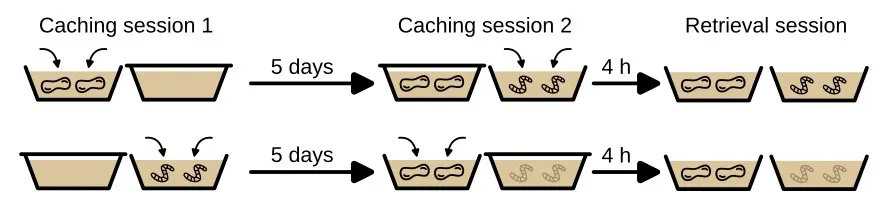 Scheme of the experimental procedure.
The Scrub jays soon learned that wax worms perish quickly. If they had cached wax worms in the first caching session—five days before the retrieval session—they avoided the worm tray because the wax worms were too decayed by then. In that case, all birds directed their first inspection to the peanut tray, although peanuts are the less preferred food item.

If, however, wax worms were cached during the second session, they were still fresh, and 80% of the jays went for the worm tray first.
You may raise the valid question: Did the birds maybe just forget about the first caching session from 5 days ago and always go for the tray they filled more recently, regardless of what they cached?
To test for this possibility, Clayton and Dickinson conducted another experiment with a separate group of Scrub jays. This group underwent the same training as the other birds, with two caching events 5 days apart, caching either worms or peanuts first. The difference was that before the retrieval session, the researchers replaced all cached worms with fresh ones. This way, the birds always had access to fresh worms, regardless of when they cached them, and hence never learned that wax worms perish.
These birds always directed their search to the worm tray first, even if the worm caching session was 5 days earlier, proving that they could very well remember the caching event that occurred longer ago.

With these important results, published 28 years ago today in Nature, Clayton and Dickinson provided the first evidence for episodic-like memory in a non-human animal. Their research revealed that Scrub jays can not only remember the where but also the what and when of past events.
Their findings have inspired fascinating research projects in the years that followed. Evidence of episodic-like memory has since been found in several other species, among them hummingbirds and pigeons, but also non-human primates (of course), fruit bats, rats, and even honeybees.
Join my mailing list to receive new blog posts directly in your inbox:
-
Clayton, N., Dickinson, A. Episodic-like memory during cache recovery by scrub jays. Nature 395, 272–274 (1998). https://doi.org/10.1038/26216 ↩︎