Why do some female hummingbirds look like males?
Maja Mielke
Male-like plumage helps female hummingbirds escape social harassment.
It is a busy day at the nectar feeder of the Canopy Tower in Panama. Buzzing in and out, male and female hummingbirds alike compete for the best spots at one of the artificial flowers.
Thanks to the Panama Hummingbird Feeder Cam of the Cornell Lab of Ornithology, you can watch the spectacle live on YouTube. What you can’t tell from the footage, though, is that not all hummingbirds that look like males are actually males.
The White-necked Jacobin (Florisuga mellivora) is a species of hummingbird from Central and South America. As is typical for hummingbirds, it is sexually dimorphic. While males have ornate plumage with shiny blue heads and throats, females have more subdued plumage, with a mottled green-gray chest.
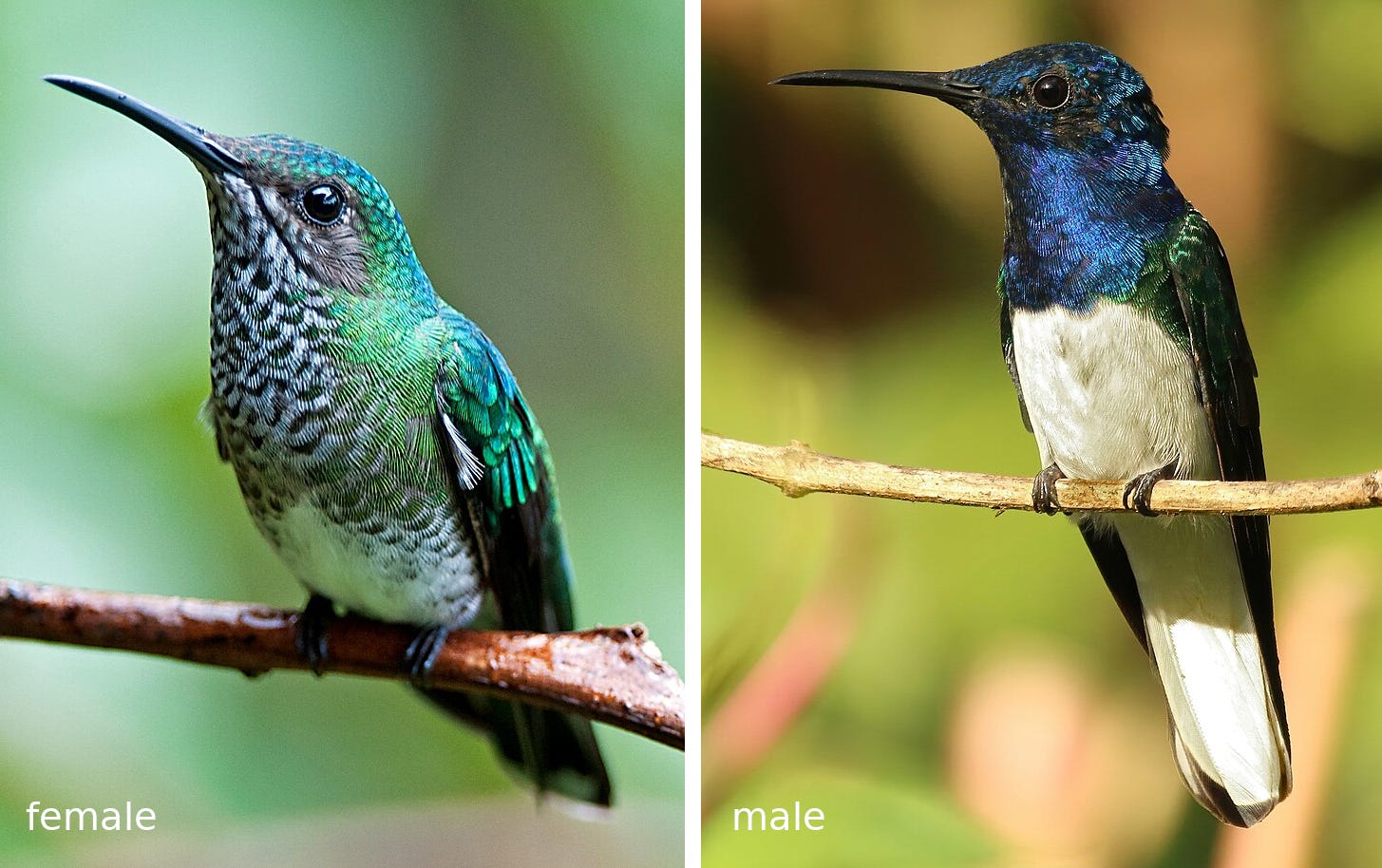 Female and male White-necked Jacobins. Image credits: Kathy & sam (left) and Charles J. Sharp (right), CC BY-SA 4.0, via Wikimedia Commons
What is special about these hummingbirds is that about 30% of females display male-like ornamented plumage, making them indistinguishable from their male counterparts! And researchers have discovered1 that male-like ornamentation makes the social life of a female hummingbird a lot easier.
For their study, the scientists conducted a fascinating social experiment. They placed different pairs of hummingbird taxidermy mounts at a nectar feeder:
- female-looking female + male
- male-looking female + male
- female-looking female + male-looking female
They then observed the reaction of approaching hummingbirds, recording both sexual behavior (courtship and copulation attempts) and aggressive behavior (physical attacks) towards the mounts.
They found that the mounts of female-looking females experienced much more aggressive behavior—both when presented together with a male and when presented together with a male-looking female. They were attacked significantly more often than their male-looking counterparts.
The researchers concluded that a male-like ornamented plumage helps females escape social harassment at nectar feeders.
Given that male-looking females did not get more sexual reactions from males (quite the opposite, in fact), this indicates that the phenomenon evolved through social selection rather than sexual selection. Rather than making females more attractive for potential mates, ornamented plumage helps them compete with fellow hummingbirds at nectar feeders, ensuring access to much-needed food resources.
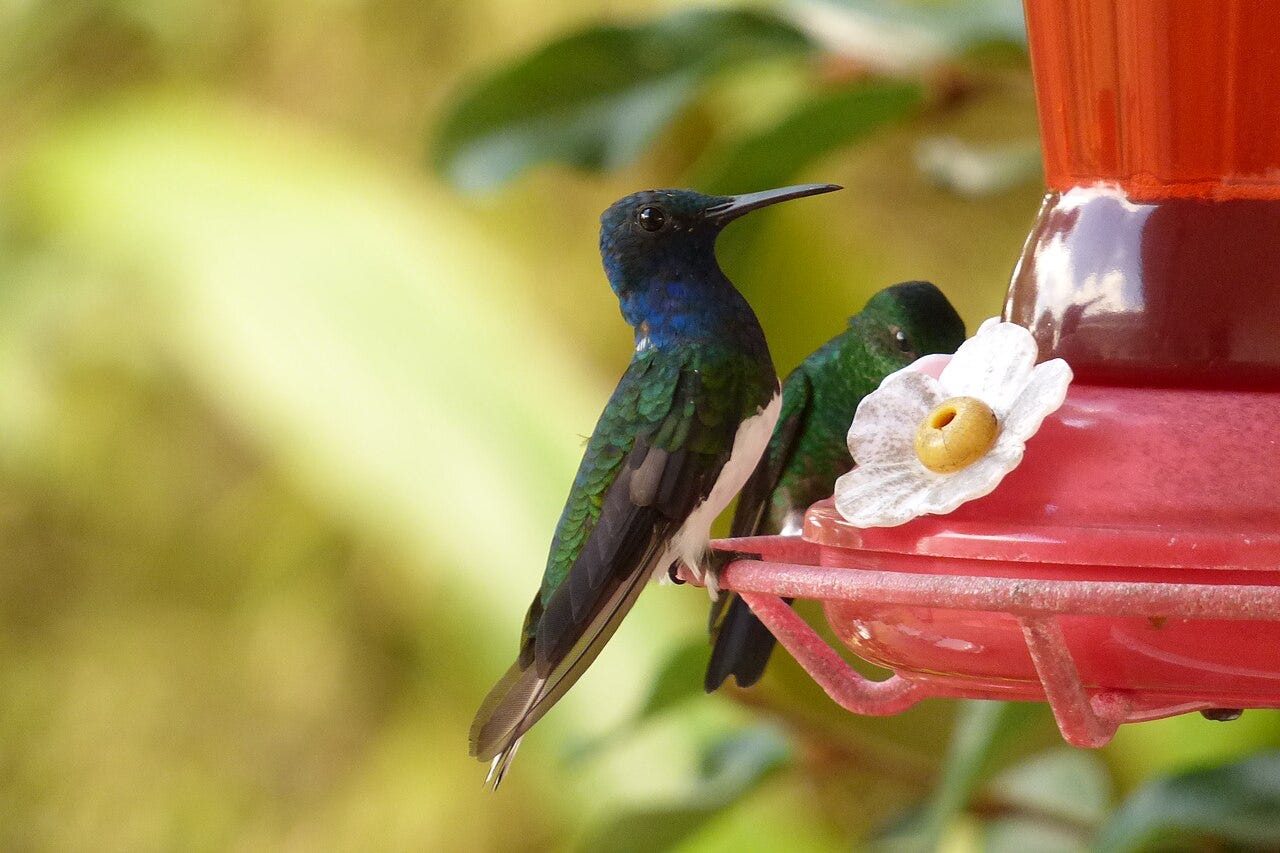 Image credit: Alejandro Bayer Tamayo from Armenia, Colombia, CC BY-SA 2.0, via Wikimedia Commons
Male ornamentation in females is surprisingly common across hummingbirds as a group. Because of their tiny body size they require a high-energy intake to stay warm and active. Regular and reliable access to high-quality food appears to be more important than being highly attractive to males.
Who can blame them?
Join my mailing list to receive new blog posts directly in your inbox:
-
Falk, J. J., Webster, M. S., & Rubenstein, D. R. (2021). Male-like ornamentation in female hummingbirds results from social harassment rather than sexual selection. Current Biology, 31(19), 4381-4387. ↩︎