Chirping with Chopin
Maja Mielke
Birds react differently to classical and rock music.
It’s a special soundscape in the gorilla house at Buffalo Zoo. Chattering of passing visitors, children laughing, a bird calling from the foliage here and there. And all of this is accompanied by the constant roar of the indoor waterfall. Suddenly, rock music is playing from the speakers, visitors turning their heads. What’s happening?
It is becoming more and more common to play music to animals in captivity. Through such ‘auditory enrichment,’ keepers hope to stimulate natural behavior and thus improve the well-being of the animals.
In mixed-species exhibits like the gorilla house at the Buffalo Zoo, such audio treatment is mostly targeted at mammals. In 2011, scientists tested1 how the gorillas reacted to different genres of music to learn whether certain types of music may improve the welfare of this critically endangered species.
But what did the birds have to say about it? At the time of the study, the gorillas shared their home with a Superb starling, two Speckled mousebirds, and two Lady Ross’s turacos. Fortunately, the scientists monitored the birds’ reactions to the music treatments as well and published their observations in a separate study in 20162.
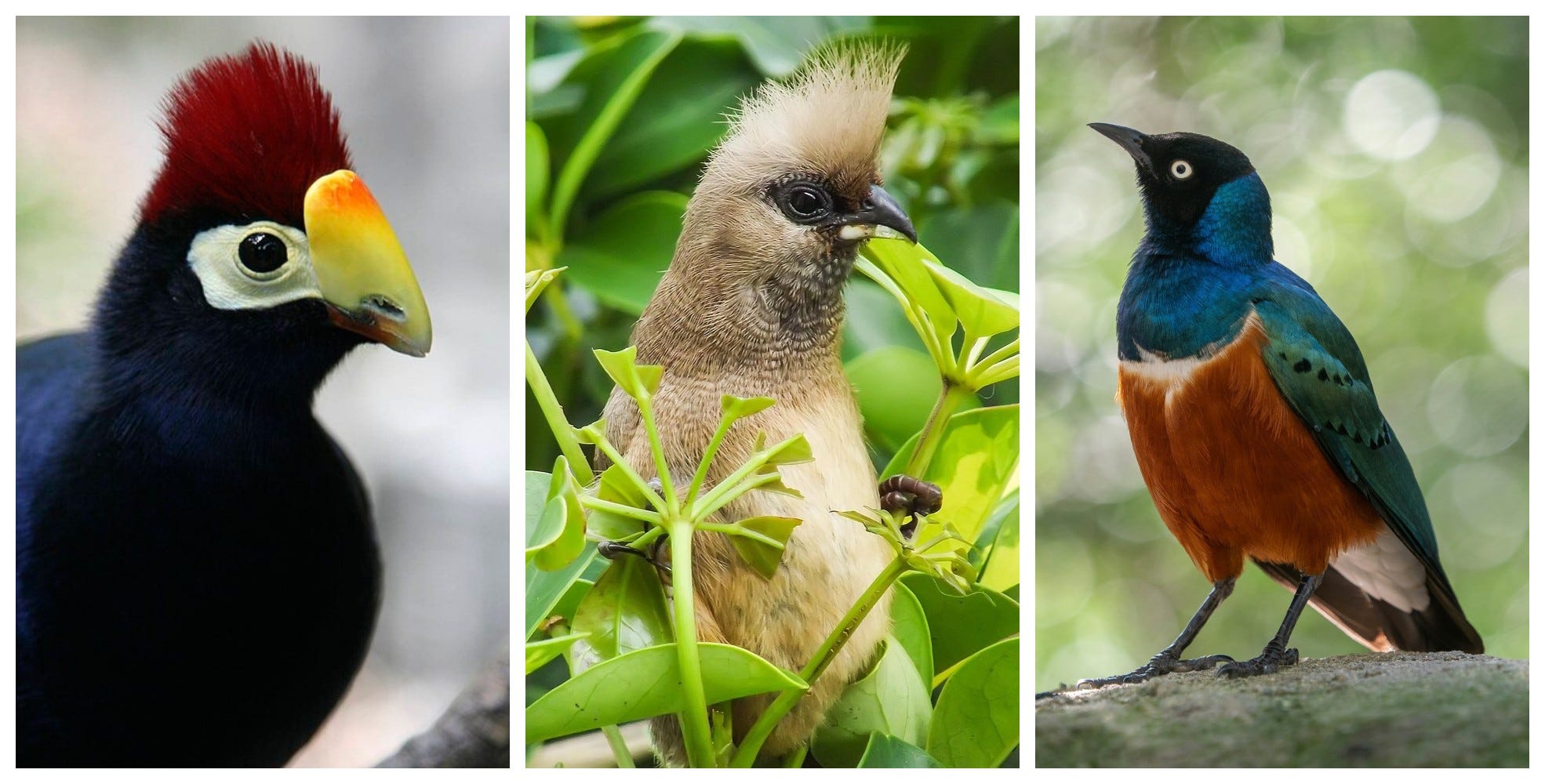 These are the species that were involved in the study. From left to right: Lady Ross’s Turacos (Musophaga rossae), Speckled Mousebirds (Colius striatus), and Superb Starlings (Lamprotornis superbus). Image credits: Ed Schipul from Houston, TX, US, CC BY-SA 2.0, via Wikimedia Commons; Sophia Nel from Pixabay, William Warby on Unsplash.
The researchers played three different types of audio in the gorilla house:
- Natural sounds from the African rainforest
- Classical music—a playlist of pieces by Frédéric Chopin
- Rock music—a playlist of songs by Muse3
While the music was playing, the scientists documented how much the birds were flying, singing, fighting, or curiously inspecting the speakers.
Here’s what they observed:
- Compared to days of no music treatment, all three species flew more often while listening to nature sounds and less often when listening to rock music.
- Nature sounds also increased the amount of vocalization, but only in the starling and mousebirds. Both species vocalized less when exposed to rock music.
- The turacos, however, vocalized more when listening to rock music, singing in duet more frequently when Muse was played.
- No fighting occurred in any of the settings.
- The birds investigated the speakers rarely, and only during the beginning of the treatments. Turacos were most curious about the source of the natural sounds, starlings about Chopin, and mousebirds about Muse. These results, however, were not significant.
You can see that different audio treatments can indeed stimulate natural behavior in these bird species. Their preferences seem to differ between the species, though.
And what about the gorillas? They showed less stereotypic behavior (such as hair plucking) when exposed to nature sounds, but more stereotypy when Chopin or Muse was played.
What can we conclude? With mixed-species exhibits, it’s like living in a shared apartment. In terms of musical taste, you can never please everyone.
Join my mailing list to receive new blog posts directly in your inbox.
-
Robbins, L., & Margulis, S. W. (2014). The effects of auditory enrichment on gorillas. Zoo biology, 33(3), 197-203. ↩︎
-
Robbins, L., & Margulis, S. W. (2016). Music for the birds: effects of auditory enrichment on captive bird species. Zoo biology, 35(1), 29-34. ↩︎
-
Quote from the article: ‘Muse was selected due to the fact that the auditory device was placed in an area where both birds and zoo visitors could hear what was being played, thus we chose music that had no vulgar language or loud, cacophonous sounds.’ ↩︎