Birds form long-term 'friendships' to help each other raise their young
Maja Mielke
Superb starlings in Kenya show that cooperative breeding is not limited to close family members.
Raising offspring is one of the most challenging tasks in life—not only for humans, but also for birds. To make their chicks thrive, birds invest tremendous amounts of energy, food resources, and parental care.
To reduce the burden, some species have developed cooperative breeding, a social system in which breeding parents receive help from non-breeding helpers, often close relatives. Helpers assist in feeding the young and defending the nest from predators. In this way, they increase the chances of their family genes being passed on to the next generation.

Now, researchers have discovered two fascinating things about cooperative breeding in Superb starlings in Kenya.
- Helpers commonly assist at nests of non-related breeders.
- They build long-term helper relationships with specific individuals in their group, taking turns in the roles of helper and breeder throughout life.
Superb starlings (Lamprotornis superbus) are obligate cooperative breeders; they breed in groups of up to 60 individuals, and around five (but sometimes up to 16) non-breeding helpers assist at each nest.
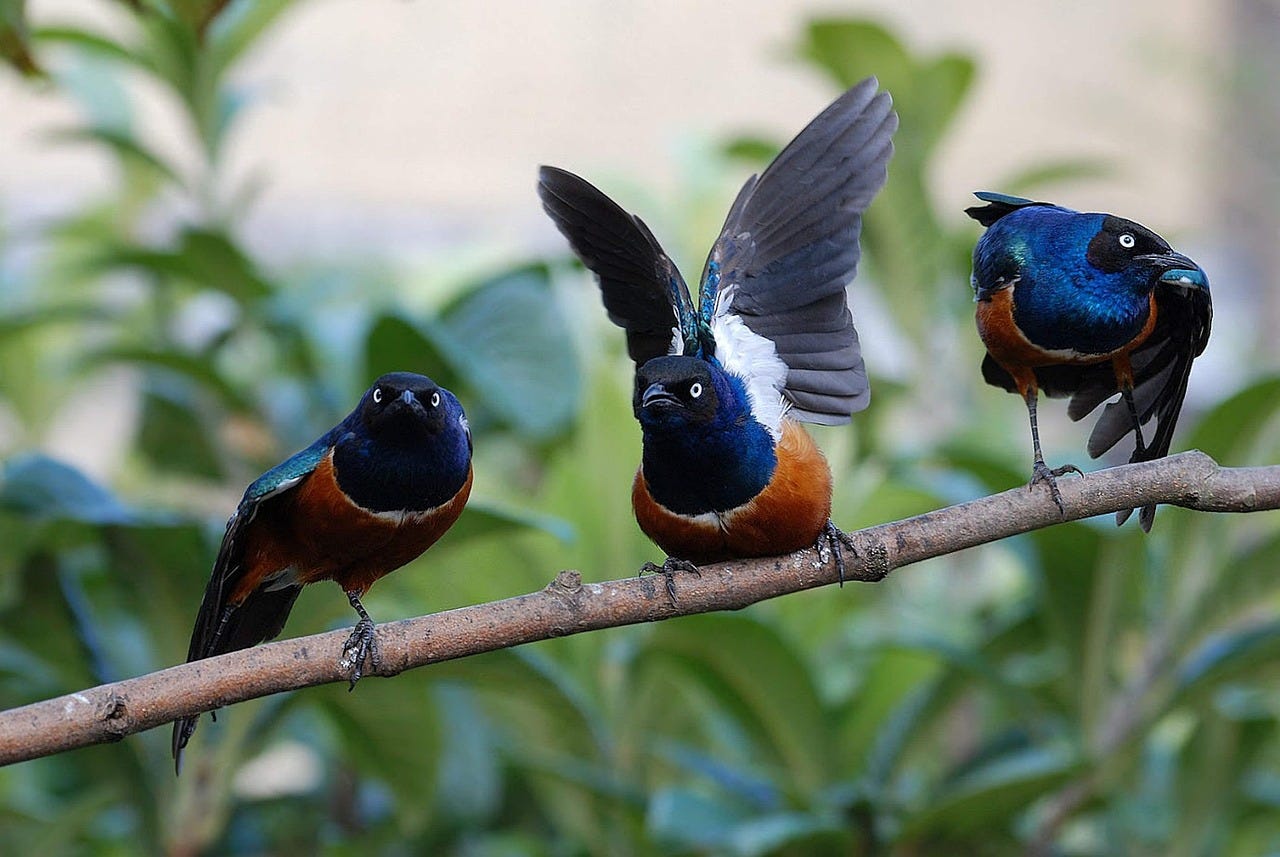 Image by Steve Bidmead from Pixabay.
For their study1, an international team of researchers observed the helping behavior of these birds for 20 years in a study site in Kenya. As these birds breed twice a year, the authors collected data on 40 breeding seasons in total, documenting more than 12,000 helping observations across 563 helpers at 410 nests across 9 social groups.
Diving into this massive dataset, the researchers discovered something surprising. While the birds did prefer helping relatives, as is typical for cooperative breeders, helping non-related birds was still common—even when they had the option to choose between helping kin and non-kin!
The scientists also discovered that the starlings formed long-term helper relationships with specific individuals (kin or non-kin). Birds in these relationships helped each other raise their young, switching roles of breeder and helper throughout their lifetime! Such reciprocal helping occurred between individuals of the same sex in about 50% of the cases, ruling out potential future reproduction as motivation for helping.

Dustin Rubenstein, professor of conservation biology and one of the authors of the study, told The Guardian:
“They’re forming these pairwise reciprocal relationships, in the sense that I might help you this year, and then you’ll help me in the future. […] You can think of them as friendships, in the sense that they’re not relatives.”
What a beautiful reminder that cooperation and care are universal—a lot for us to learn from.
Join my mailing list to receive new blog posts directly in your inbox.